
Capabilities

Agentic AIcapabilitiesfor deterministicoperations.

We build supervised agentic workflows, the control plane around them, and the architecture and governance required to keep execution deterministic in production.

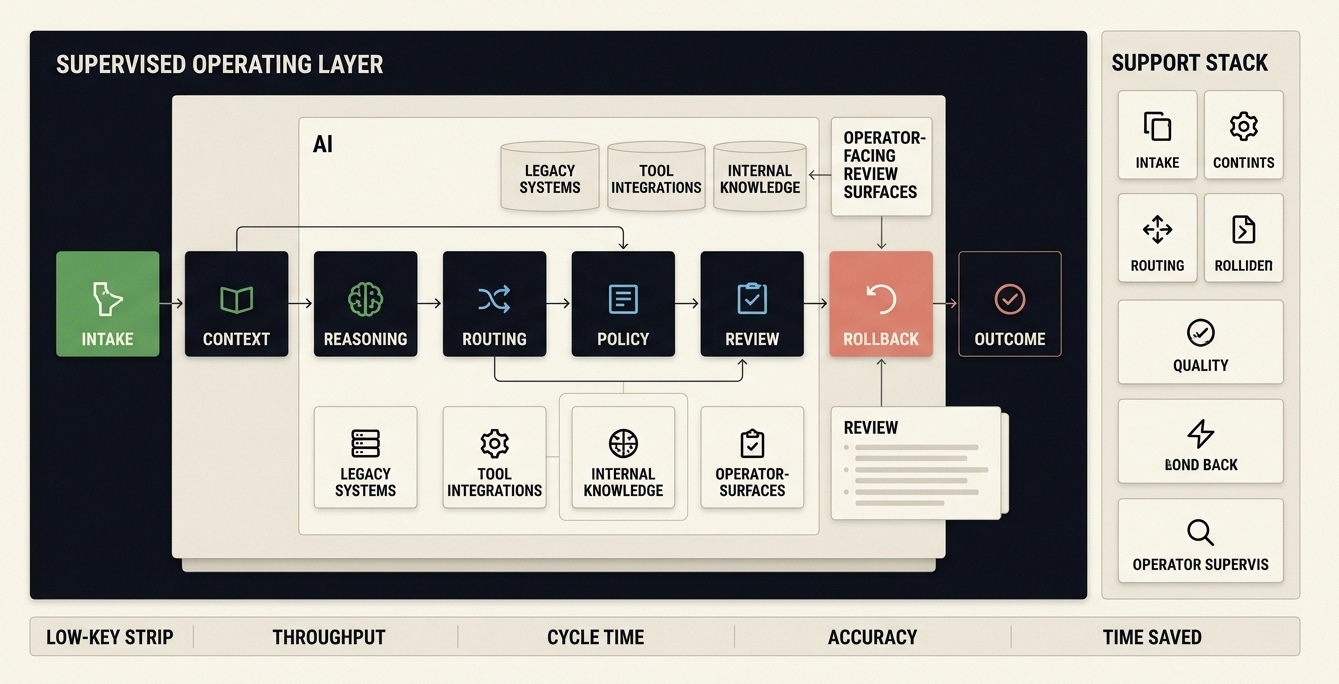
Capabilities hero illustration showing a deterministic agentic operating system.

Capability 01

Workflow orchestration

Operational focus

Design supervised agentic workflows with deterministic routing, approval logic, and exception handling across fragmented operations.

Outcomes

Typical deliverables

  • More deterministic case triage and handoffs
    Agent workflow map and deterministic automation boundaries
  • Lower administrative drag on high-value teams
    Task graph, tool permissions, and escalation rules
  • Explicit exception paths instead of brittle RPA breakpoints
    Operational dashboards for queue health and supervised throughput
Capability 02

Architecture and integrations

Operational focus

Design an API-first agent architecture that can reason across CRMs, ERPs, EHRs, analytics stacks, and internal knowledge bases without losing deterministic control.

Outcomes

Typical deliverables

  • Lower vendor lock-in across agent stacks
    Composable agent service map
  • Safer model and tool swaps as the landscape changes
    Retrieval, memory, and context architecture
  • Reusable agent services instead of one-off automations
    Integration contracts, tool adapters, and observability patterns

Capability 03

Guardrails and governance

Operational focus

Constrain agent reasoning with deterministic policies, approvals, and rollback paths so regulated workflows stay automatable and accountable.

Outcomes

Typical deliverables

  • More deterministic execution in risky workflows
    Data contracts, policy models, and access controls
  • Clear approval thresholds for agent actions
    Policy gates, human approvals, and rollback paths
  • Audit trails that support review and remediation
    Logging, monitoring, and explainability views

Capability 04

Operator control plane

Operational focus

Design the control plane people use to supervise AI agents, inspect decisions, intervene in-flight, and continuously tune highly deterministic workflows.

Outcomes

Typical deliverables

  • Higher trust from operators and leadership
    Control-plane interfaces, queue views, and status surfaces
  • Faster intervention when workflows drift or stall
    Exception handling, review tooling, and feedback loops
  • Continuous improvement without re-platforming
    Operational playbooks for launch and scale

What we avoid

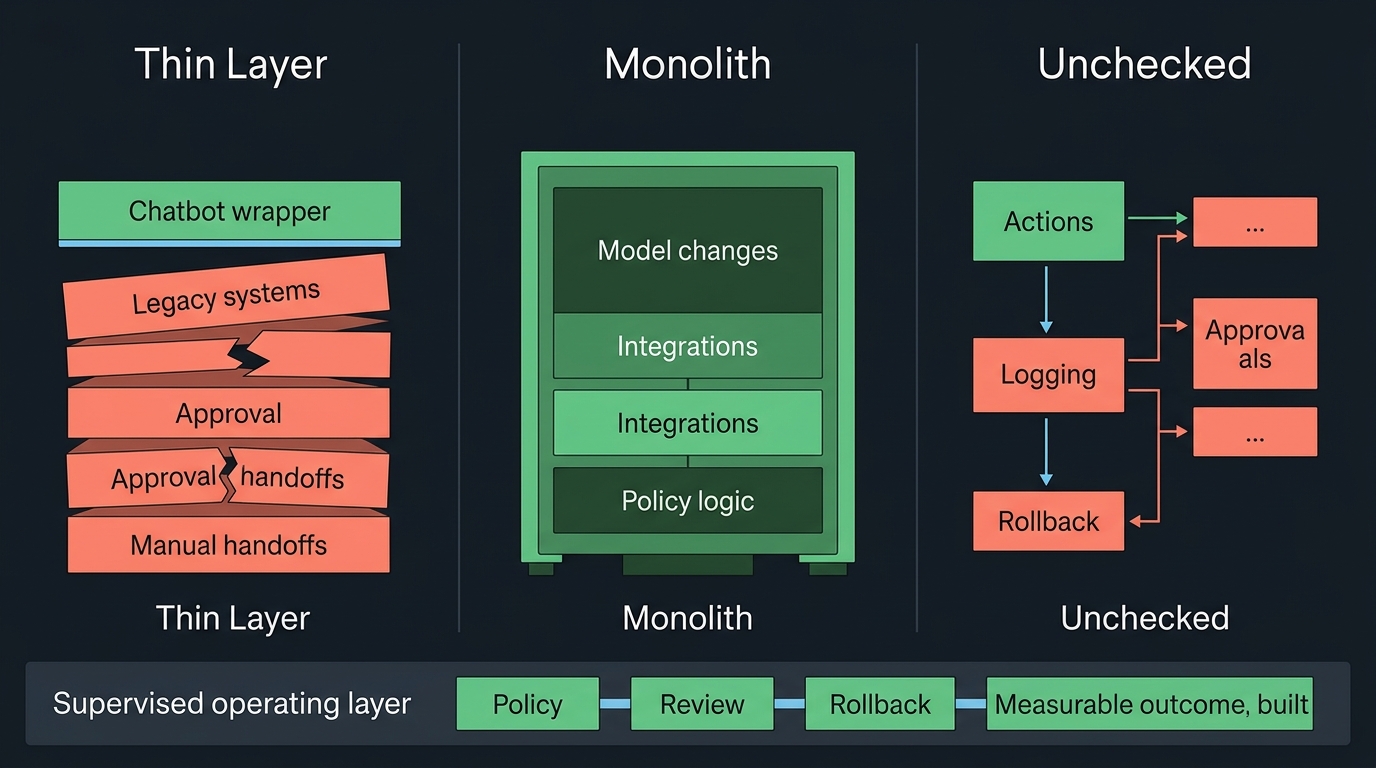
We do not treat AI as a thin layer over broken operations.

The fastest way to ship a bad automation program is to wrap broken workflows in a model and call it transformation. These are the patterns we refuse to build.

Anti-pattern comparison illustration for bad AI automation approaches.

01 / anti-pattern

Chatbot wrappers

Single-purpose chatbot rollouts with no operating model behind them.

Rejected by design

02 / anti-pattern

Custom monoliths

They make model changes expensive, brittle, and difficult to govern.

Rejected by design

03 / anti-pattern

Unchecked execution

Autonomous paths that bypass approvals, logging, or policy gates.

Rejected by design

Next step

Pick the workflow, then design the control plane around it.

Delivery stance

Launch one supervised workflow, prove the economics, then scale the service layer into adjacent operations.